

Understanding Regional Differences
You need something translated into Spanish. Simple enough, right?
Not quite. Spanish is spoken by over 500 million people across 20+ countries — and the version that works in Madrid can quietly undermine a contract in Buenos Aires, confuse a customer in Mexico City, or create compliance problems in Bogotá. The language is the same. The rules are not.
Table of Contents
The Myth of One Universal Spanish
Most companies assume Spanish is interchangeable. One translation, every market. Done.
That assumption works fine for casual content. But the assumption fails for corporate documents, contracts, and regulated communications, sometimes at significant expense.
Spanish is not a single standard. It is a family of regional variants with meaningful differences in vocabulary, legal terminology, tone, and regulatory language. Treating it as uniform is the same as assuming British English contracts work without modification in the United States.
They don’t. Neither does generic Spanish.
The risk is not obvious until something goes wrong. A clause that reads as legally binding in one jurisdiction is ambiguous in another. A product description that sounds professional in Spain sounds awkward or even offensive in parts of Latin America. A compliance document written in “neutral Spanish” may not meet local regulatory requirements at all.
The myth of universal Spanish costs companies money. The solution is to understand where the differences actually lie, and to build a localization strategy around them.
Spain vs. Latin American Spanish — What Actually Changes
The gap between Castilian Spanish and Latin American Spanish is wider than most clients expect. Here is where it matters most in a corporate context.
Terminology Differences in Corporate Context
Every day, business vocabulary diverges significantly between regions.
In Spain, a mobile phone is a móvil. In Latin America, it is a celular. A computer is an ordenador in Spain and a computadora or computador in most of Latin America. A car is a coche in Spain, an auto or carro across the Americas.
These are not minor stylistic choices. In product documentation, technical manuals, or marketing materials, the wrong regional term signals immediately to your audience that the content was not written for them.
Corporate credibility depends on sounding local. A multinational that distributes Spain-translated materials to a Colombian distributor sends an unspoken message: we did not think about you specifically.

Legal and Contractual Variations
This is where regional differences move from inconvenient to consequential.
Legal systems in Latin America are based on civil law traditions, but each country has developed its own statutory language, contract conventions, and jurisdictional terminology. What constitutes a valid clause in a Mexican commercial contract differs from Argentine or Chilean practice.
Specific terminology matters in contract translation. Terms like fianza (surety bond), mandato (power of attorney), rescisión vs. resolución (two distinct types of contract termination) carry precise legal meanings that vary by jurisdiction. Translating a contract without understanding those distinctions creates documents that are technically in Spanish but legally imprecise — or worse, ambiguous to a local court.
Can incorrect regional Spanish affect the validity of a contract? Definitely, ambiguous or jurisdiction-inappropriate terminology has been cited in contract disputes as grounds for challenging enforceability. It’s not common, but it is a documented risk.
Regulatory and Compliance Language
Regulated industries, such as pharmaceuticals, food and beverage, financial services, and energy, face an additional layer of complexity.
Each country has its own regulatory bodies, official terminology standards, and approved language for labeling, disclosures, and compliance documents. Argentina’s ANMAT, Mexico’s COFEPRIS, and Spain’s AEMPS do not use identical language for the same concepts.
Submitting compliance documentation in the wrong regulatory dialect is a rejection risk. In some cases, it triggers re-review cycles that linger for weeks. In others, it creates liability exposure.
Tone and Business Communication Norms
Spain uses vosotros as the second-person plural. Latin America does not; ustedes serves that function across the region. This is basic, but it is immediately noticeable to any Latin American reader.
Beyond pronouns, the formality register shifts significantly.
Corporate communication in Argentina and Uruguay tends to be warmer and more relationship-oriented than in Spain, where directness is more valued. Chilean business writing is notably formal. Mexican corporate communication balances formality with politeness markers that differ from both.
Getting the tone wrong does not invalidate a document. It does undermine trust, and in business communication, trust is the point.
What Is “Neutral Spanish” — And When It Fails
You may have heard the term neutral Spanish or español neutro. It refers to a standardized, regionless form of Spanish designed to be broadly understood across markets.
Neutral Spanish has legitimate uses. Dubbing for films and television, pan-regional advertising campaigns, and general consumer content aimed at the widest possible audience are all reasonable applications. When you need to reach everyone without offending anyone, neutral Spanish is a defensible choice.
Neutral Spanish is widely used in the United States and Canada, and serves to communicate with Spanish-speaking residents on everyday life subjects. Given the variety of origins the readers come from, it’s very forgiving. That is, you expect neutral Spanish to communicate in some terms that may not be native to the reader, but they are understood nonetheless.
But neutral Spanish is a compromise, and compromises have limits.
It fails in contracts. Legal documents require jurisdiction-specific terminology. Neutral Spanish lacks the precision that local courts, lawyers, and regulatory bodies expect. A contract written in neutral Spanish is not wrong, but it is generic where it needs to be exact.
Not apt for compliance documentation. Regulatory filings must match the language standards of the target country’s authority. A neutral Spanish pharmaceutical label does not satisfy COFEPRIS requirements written for Mexican Spanish conventions.
In high-stakes corporate communication, it underperforms. Executives and legal teams in Buenos Aires, Santiago, or Bogotá notice when a document was written for no one in particular. It signals a lack of investment in the relationship.
Neutral Spanish is a starting point, not a solution. For corporate-grade translation, it’s the floor, not the ceiling.
Risk Management in English to Spanish Translation
Poor localization is not just an embarrassment. It carries measurable business risk.
Brand perception. Your Spanish-language materials are your brand in those markets. Awkward phrasing, wrong regional vocabulary, or a tone that feels foreign signals that you did not invest in understanding your audience. That impression is hard to reverse.
Corporate liability. Contracts, terms of service, employee agreements, and compliance documents that contain ambiguous or jurisdiction-inappropriate language create legal exposure. The cost of a translation dispute is almost always higher than the cost of getting the translation right the first time.
Regulatory compliance. In regulated industries, non-compliant language in official documentation can delay market entry, trigger re-review, or result in fines. Localization is not an optional refinement — it is a compliance requirement.
Multinational deployment. Companies operating across multiple Spanish-speaking markets need a clear strategy. A single translation that works everywhere does not exist. What works is a structured approach: core content translated to a high standard, then adapted for each target market’s terminology, regulatory context, and communication norms.
Translation is not a cost. It is risk management. The companies that treat it as a line item to minimize are the ones that eventually pay for it elsewhere.
Beyond Neutral Spanish Translation
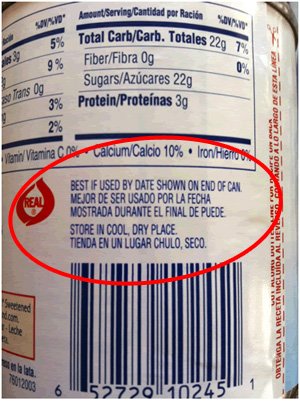
Here is an example of a company that wants to appeal to the Latin American market, but paid no attention to the translation of its product’s food label.
Indications: “BEST IF USED BY DATE SHOWN AT THE END OF CAN. STORE IN COOL, DRY PLACE”
5 Major mistakes that would make any Latin American reader cringe:
- Translation: “Mejor de ser usado…”
- Translation: “…por la fecha.”
- Translation: …el final del puede.”
- Translation: “Tienda en…”
- Translation: “…un lugar chulo…”
Proper translation: “Utilizar antes de la fecha indicada al final de la lata. Almacenar en un lugar fresco y seco.”
How to Choose the Right Spanish Localization Strategy
The right approach depends on what you are translating, where it is going, and what is at stake.
Winning companies approach material translation strategically, recognizing it not as an inevitable expense, but as an important investment.
Single-country targeting is the simplest case. You know your market, you know your regulatory environment, and you need translation that is precise for that jurisdiction.
This is where regional specialization matters most; a translator who knows Chilean contract law is not interchangeable with one who knows Colombian regulatory language.
Multi-country deployment requires a more structured approach. Start with a high-quality base translation, then adapt for each target market.
This is more expensive than a single pass, but significantly cheaper than litigation, regulatory rejection, or brand damage.
Terminology governance matters at scale. If your company produces high volumes of Spanish content across multiple markets, building a centralized glossary of approved regional terminology is an investment that pays for itself quickly.
Consistency across documents, markets, and time reduces review cycles and minimizes error.
Work with translators who know your industry. A legal translator and a marketing translator are not the same professional.
For contracts, compliance documents, and technical manuals, subject matter expertise is not optional; it is the difference between a document that works and one that creates problems.
Frequently Asked Questions on Spanish Translation
Let’s Talk About Your Project
Your Spanish-language documents represent your company in markets where precision matters. Whether you need a single contract reviewed, a compliance document localized for a specific jurisdiction, or a multi-market deployment strategy, the right approach starts with understanding exactly where you are going and what is at stake.
